







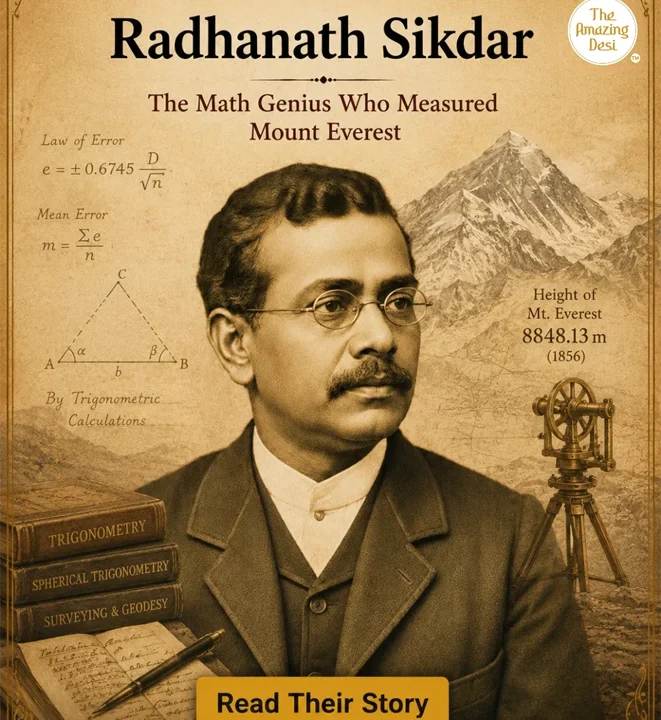
Radhanath Sikdar was the man who identified the highest point on Earth, yet he was overlooked when it came time to give out credit. If history had been fairer and less influenced by colonialism, the world’s tallest peak might be called Mount Sikdar.
Born in 1813 in Kolkata, Radhanath was a child of the Bengal Renaissance. His journey began at the prestigious Hindu College, where he fell under the spell of Henry Louis Vivian Derozio. This wasn’t just a school; it was a breeding ground for radicals. As a “Derozian,” Radhanath learned to treat logic as his only master. While his peers were debating poetry, he was obsessed with the absolute certainty of mathematics. He saw numbers not as dry data, but as a way to decode the physical world. This passion led him to the Great Trigonometrical Survey (GTS) in 1831.
Joining the GTS was a major step, but as an Indian, Radhanath faced real barriers due to colonial attitudes. He was hired as a ‘Native Computor’ with a modest salary of ₹30. For years, he worked behind British officers who often lacked his skill but had the advantage of their background. Still, Radhanath stood out for his determination. He was more than just a ‘calculator’; he was a pioneer. He improved the Least Squares Method and became an expert in spherical trigonometry, making himself essential to the Surveyors General, including George Everest. He was the person they turned to when the data was confusing.
His big moment came in 1852. While based in Dehradun, he received the raw observations for Peak XV. For years, surveyors had been squinting at this peak from 100 miles away in the plains of Bihar because Nepal was closed to them. The data was a mess of contradictions caused by atmospheric refraction—the way light bends and dances through layers of air, making mountains look taller or shorter than they are. Radhanath spent months submerged in complex equations, “cleaning” the data to account for the Earth’s curvature and these optical illusions. When the math finally surrendered, he announced he had found the world’s highest peak at exactly 29,002 feet.
The Full Story
Many people say the British took credit for Sikdar’s work, but the truth is more complicated. Sir Andrew Waugh, the Surveyor General, praised Sikdar’s talent in his notes, calling him a ‘mathematical phenomenon.’ However, British policy required naming peaks after former Surveyors General if there was no widely accepted local name. Radhanath was respected during his lifetime, but later history books often gave more attention to European figures.