







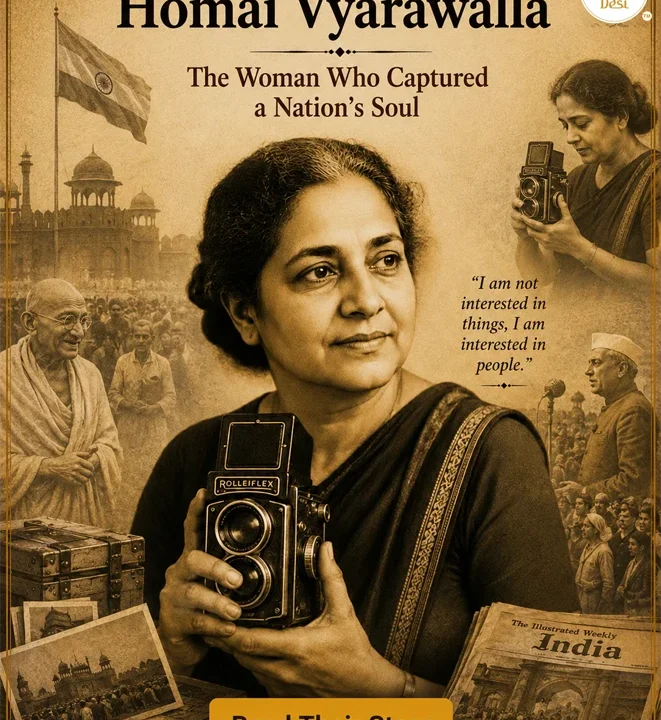
Imagine being a photojournalist in 1930s India, lugging around a camera that weighed as much as a toddler, all while navigating massive political rallies in a saree. That was Homai Vyarawalla, India’s first female photojournalist. Her life was a masterclass in breaking into the ultimate “boys’ club” through sheer persistence and talent.
Born in 1913 to a Parsi family in Gujarat, Homai’s early life was nomadic because her father was an Urdu theatre actor. This exposed her to the visual drama of storytelling at an early age. When she moved to Mumbai to study at the JJ School of Art, she met her husband, Maneckshaw Vyarawalla, who taught her the technical aspects of photography. But the vision was all hers. She began taking photos for the Illustrated Weekly of India, but because the world wasn’t ready for a female name on a byline, she adopted the pseudonym “Dalda 13.” She was a force of nature. At political rallies where thousands of men would be jostling for space, Homai was right there in the middle, balancing her heavy Speed Graphic camera and pushing for the perfect angle. In an engrossing interview with The Hindu, when asked if she ever felt hampered in her work because of being a woman, Homai said: “Somehow it never occurred to me that I was doing something unusual or that I was the only woman in a male-dominated profession at that time. I think I was casual in my dressing and unobtrusive in my demeanour, so this may have made people around me feel at ease. I was always given due credit for my work and was respected just as any other competent person in the field. At school, I was the only girl in my matriculation class. So I was used to being in the company of boys.”
She didn’t just take pictures; she documented the birth pangs of a nation. Her lens captured the most iconic moments of the 20th century: the 1947 flag hoisting at the Red Fort, the funeral of Mahatma Gandhi, and the moment a young Dalai Lama crossed the border into India in 1959. She had a unique, almost protective bond with Jawaharlal Nehru, capturing him in candid moments that made the “Architect of India” look remarkably human.
Her path to glory was built on being “invisible.” She believed a photographer should never interfere with the scene. But by 1970, the world changed. The “gentlemanly” era of photojournalism was replaced by a pushy, aggressive “paparazzi” culture that she detested. After her husband died, she decided she had seen enough. She didn’t just retire; she walked away completely. She packed her bags, moved to a quiet apartment in Vadodara, and spent her time fixing her own plumbing and driving her own car, far from the limelight she had helped create for others.
Did You Know?
Homai was a total purist. When she retired, she stayed away from cameras for decades. She even destroyed her own negatives at one point because she felt the world no longer valued the integrity of the image. It was only in her late 80s that she was “rediscovered” by a new generation and finally awarded the Padma Vibhushan in 2011.
Resources
Image Credit : Photo courtesy: HV Archive/ The Alkazi Collection of Photography
https://www.thequint.com/photos/iconic-images-homai-vyarawalla-india-first-woman-photojournalist#17
https://www.aakritiartgallery.com/artnewsnviews/the-lady-in-the-rough-crowd-archiving-in.html