







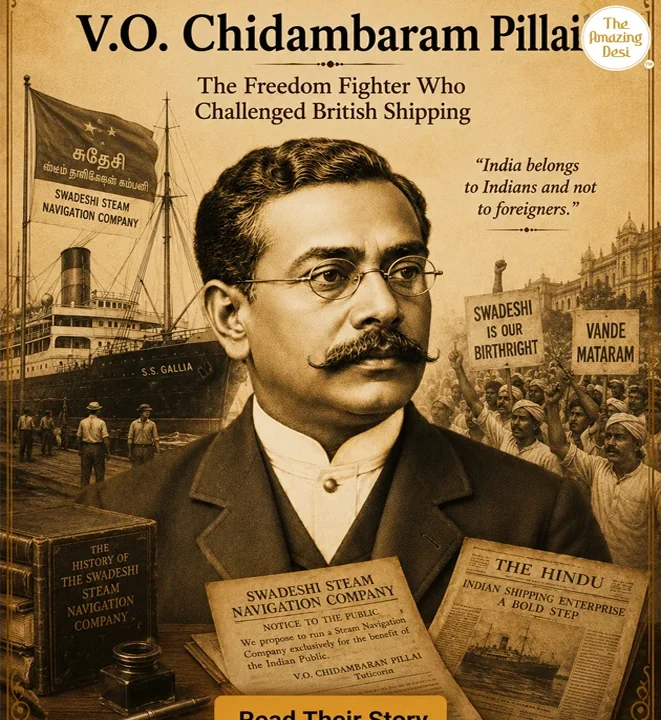
V.O. Chidambaram Pillai (VOC) was a successful lawyer who realised that the British didn’t just rule India with guns—they ruled it through economic monopolies. He watched as the British India Steam Navigation Company (BISN) dominated the shipping route between Tuticorin and Colombo, treating Indian passengers like second-class citizens and bleeding local merchants dry.
In 1906, VOC decided to do the impossible: he started the Swadeshi Steam Navigation Company (SSNCo). This wasn’t just a business; it was a maritime rebellion. He raised ₹10 lakhs—a fortune at the time—by travelling across the country and convincing thousands of small investors to buy shares. He eventually bought two massive ships, the SS Galia and the SS Lavo. For the first time in centuries, an Indian-owned flag was flying on the high seas, challenging the British Empire on its own turf.
The British didn’t take this well. They tried to buy VOC off, and when that failed, they launched a brutal price war. BISN started offering free tickets and even umbrellas to passengers just to bankrupt VOC’s company. But the people of Tuticorin stood by him. Terrified by his growing influence, the British arrested him in 1908 on charges of sedition. The resulting riots were some of the most intense in South India’s history.
Did You Know?
VOC’s punishment was unusually cruel. He was sentenced to double life imprisonment (40 years) and forced to pull a heavy oil press (chekku) in the prison yard—a job usually reserved for oxen. While his company eventually collapsed and his ships were sold back to the British while he was in jail, he became a legend. He was eventually released in 1912, but his health and wealth were gone. Today, he is revered as “Kappalottiya Thamizhan”—the Tamil who steered the ships.