







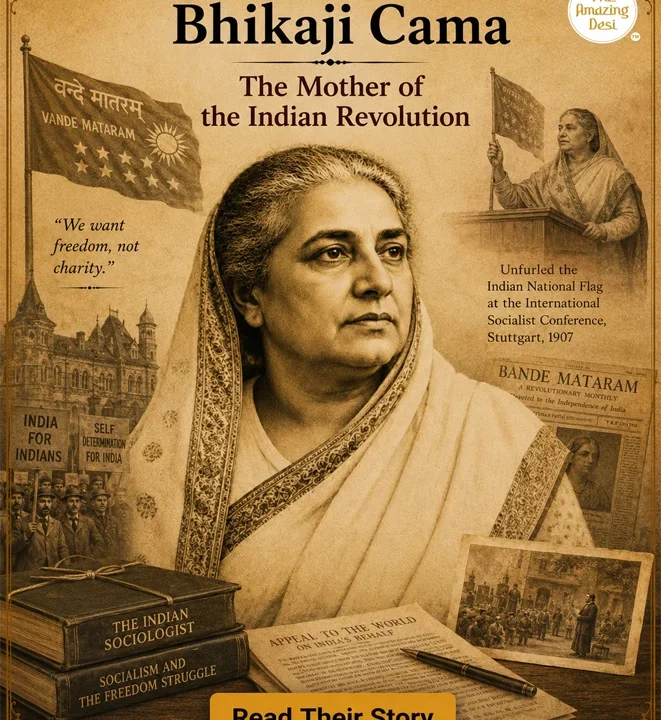
Bhikaji Cama was born in 1861 into a life of luxury in Mumbai, but she ended up being one of the most “wanted” women in the British Empire. Her story is one of a “Rich Girl” turned radical, a woman who sacrificed her status, her health, and her home for a dream of freedom she would barely live to see.
Raised in a wealthy Parsi family, her life changed forever during the 1896 plague in Mumbai. While others fled, Bhikaji stayed to nurse the sick. She worked so tirelessly that she contracted the plague herself and was sent to Europe to recover. That medical trip turned into a 35-year exile. In London, she met the legendary Dadabhai Naoroji and realised that India’s poverty was a direct result of British drain. The British government offered her a chance to return home, but with a catch: she had to sign a pledge to stop her “anti-British” activities. Bhikaji’s response? She moved to Paris and ramped up the revolution.
In 1907, she achieved immortality at the International Socialist Congress in Stuttgart, Germany. In front of a stunned international audience, she unfurled the first version of the Indian National Flag—a tricolour of green, saffron, and red with “Vande Mataram” written in the centre. She told the world, “Behold, the flag of independent India is born! Pay heed to it!” It was a masterstroke of political theatre that put India’s struggle on the global map. From her home in Paris, which became a headquarters for revolutionaries like Savarkar, she smuggled banned newspapers into India inside toy boxes and crates of tea.
The Full Story
While we celebrate her as a freedom fighter, she was also a fierce advocate for women’s rights. In her speeches, she often reminded her male colleagues that a nation cannot be free if its women are enslaved. Interestingly, the British only allowed her back into India in 1935 when she was 74 and dying, on the condition that she wouldn’t participate in politics. She died just nine months after returning, a lonely but unbowed figure.
“Design of the “Flag of Indian Independence” raised by Bhikhaiji Cama on 22 August 1907, at the International Socialist Conference in Stuttgart, Germany. Based on the Calcutta Flag, drawn by Hemchandra Kanungo and Sachindra Prasad Bose, the green, yellow and red fields represent Islam, Hinduism, and Buddhism respectively. The crescent moon and the sun again represent Islam and Hinduism, respectively. The eight lotuses in the upper register represent the eight provinces of British India. The words in the middle are in devanagri script and read Vande Mataram “[We] Bow to thee Mother [India]”, the slogan of the Indian National Congress.The design was adopted in 1914 as the emblem of the Berlin Committee (later known as the Indian Independence Committee). The original “Flag of Indian Independence” raised by Cama in Stuttgart is now on display at the Maratha and Kesari Library in Pune”
Resources:
https://en.wikipedia.org/wiki/Bhikaiji_Camahttps://feminisminindia.com/2018/03/30/bhikaji-cama-exile-indian-flag/
https://storypick.com/the-story-of-bhikajicama/
http://images.indiatvnews.com/mainnational/2016/1457399551bikhaji-cama.jpg http://www.savarkar.org/gallery2/gallery/d/372-5/IMG9.jpg