








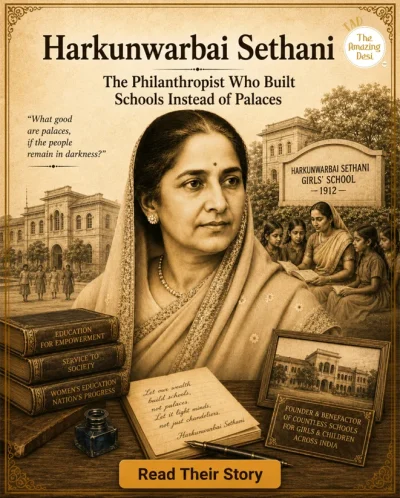
If you think the “Social Entrepreneur” is a modern invention, you haven’t met Harkunwar Sethani. Born in 1810 into a wealthy Jain trading family in Gujarat, Harkunwar was a woman who understood the power of the ledger better than anyone. Her life took a dramatic turn when her husband, the textile tycoon Hutheesing, died young. In 19th-century India, a widow was expected to fade into the background. Harkunwar did the opposite: she stepped into the boardroom.
The challenge was a society that thought women shouldn’t be educated, let alone lead a multi-million-rupee business empire. Harkunwar didn’t just maintain her husband’s banking and textile business; she expanded it. But she was obsessed with what that wealth could do for the city of Ahmedabad. In 1847, she founded the city’s first girls’ school. She didn’t just sign a check; she designed the curriculum and made sure it was a place where girls could learn to think for themselves. She overcame the sceptics by showing them that an educated workforce was better for everyone.
Her path to glory is etched in the architecture of Gujarat. She commissioned the famous Hutheesing Jain Temple, a masterpiece of stone carving. But here’s the “CEO” move: she chose to build it during one of the worst famines in Gujarat’s history. She didn’t want to just give out “charity,” which she felt stripped people of their dignity. Instead, she used the temple project as a massive infrastructure scheme to provide high-paying jobs for thousands of starving artisans and labourers for years.
The Full Story
While she is often remembered for the temple, Harkunwar was a pioneer of “Work-Relief” programs. She understood “Dignity of Labour” long before it became a political slogan. However, because she worked within the traditional Jain religious framework, modern business historians often overlook her as one of India’s earliest and most successful female industrialist-philanthropists. She proved that you could be a devout traditionalist and a radical social reformer at the same time.